
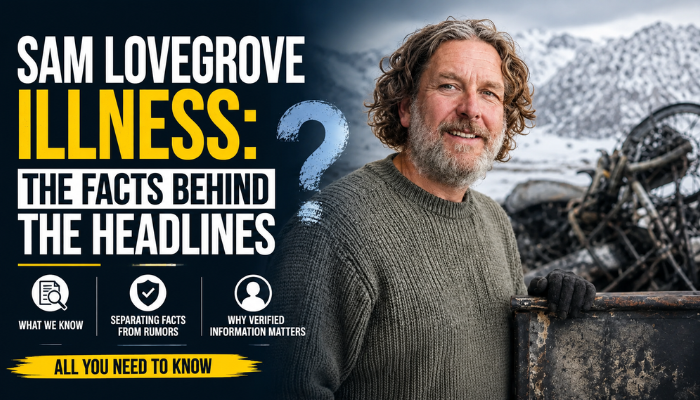

Sam Lovegrove illness has become a search term that continues to attract attention online. As interest grows, many readers are looking for accurate information about whether there have been any confirmed reports regarding his health. Unfortunately, the internet often mixes facts with speculation, making it difficult to distinguish verified updates from rumors.
This article explores what is publicly known about Sam Lovegrove illness, why the topic has gained attention, and the importance of relying on credible information. Rather than repeating unverified claims, this guide focuses on facts, responsible reporting, and the broader context behind online discussions.
Who Is Sam Lovegrove?
Sam Lovegrove is recognized for his work and public presence, leading many people to follow updates about his career and personal life. Like many public figures, he occasionally becomes the subject of online discussions that extend beyond his professional achievements.
Whenever someone gains public attention, curiosity naturally increases. Fans often search for updates about their favorite personalities, including their health and well-being. This growing interest explains why keywords like Sam Lovegrove illness appear in search engine trends, even when there is little or no confirmed information available.
Public curiosity, however, should not be confused with verified news. Responsible reporting requires confirmation from reliable sources before presenting health-related information as fact.
Why Are People Searching for “Sam Lovegrove Illness”?
Search trends are influenced by many factors. Social media conversations, online forums, and search suggestions can quickly increase interest in a particular topic. Sometimes a single rumor can encourage thousands of people to search for more information.
In the case of Sam Lovegrove illness, searches may be driven by curiosity rather than confirmed reports. Search engines display what users are looking for, not necessarily what has been verified. As a result, a popular keyword does not automatically indicate that an event has occurred.
This highlights the importance of checking reputable news organizations, official statements, or verified social media accounts before accepting health-related claims as true.
What Has Been Publicly Confirmed?
At the time of writing, there is no widely confirmed public information verifying a specific illness involving Sam Lovegrove. While various online discussions may exist, speculation alone should never be treated as evidence.
Responsible journalism places great importance on verified facts. Unless a public figure personally shares health information or trusted news organizations confirm it, any claims should be viewed with caution.
Privacy is also an important consideration. Even well-known individuals deserve respect regarding personal medical matters. Unless information has been voluntarily disclosed, assumptions should be avoided.
How Health Rumors Spread Online
Modern social media platforms allow information to spread within minutes. Unfortunately, this also means misinformation can reach large audiences before it is corrected.
A misleading headline, an edited image, or an unverified post can quickly become widely shared. As more people search for terms like Sam Lovegrove illness, search engines may display those queries more frequently, creating the impression that the rumor has greater credibility than it actually does.
Readers should evaluate information carefully by checking:
- Official statements
- Established news organizations
- Verified interviews
- Multiple independent sources
Following these steps helps reduce the spread of misinformation and encourages responsible online discussions.
How to Stay Updated Responsibly
If verified information regarding Sam Lovegrove’s health is ever released, it is most likely to come from official representatives or respected news organizations.
Instead of relying on anonymous social media posts or clickbait articles, readers should follow trusted sources for updates. This approach helps ensure that any information they receive is accurate, respectful, and supported by evidence.
Ultimately, curiosity is understandable, but accuracy is even more important. Responsible readers and publishers both play a role in preventing the spread of false information.
What “Sam Lovegrove Illness” Usually Means in Online Discussions
The phrase “sam lovegrove illness” often appears when an individual experiences a health setback that becomes visible to fans, followers, or media outlets. But in many cases, what the public calls an “illness” may include a range of possibilities: a short-term condition (like a sudden infection), a longer-term medical issue (like a chronic condition), or even a recovery period that follows a procedure. Online discussions can also blur the line between symptoms, diagnoses, and simply “not feeling well.”
To make sense of these conversations, it helps to separate what’s known from what’s inferred. Known information tends to be based on direct statements, credible medical context, or consistent reporting across reliable outlets. Inferred information is what people guess from limited clues—like changes in appearance, posts that feel “off,” or statements that are intentionally vague. When readers are searching for the facts behind the headlines, this distinction is the first step toward clarity.
Another common reason the keyword shows up is timing. When someone is absent, delays content, or cancels an appearance, viewers search for a cause. But “absence” alone doesn’t confirm an illness; it can also be due to mental health breaks, scheduling issues, travel complications, or personal matters. Understanding this helps readers avoid the trap of assuming the worst (or assuming any illness at all) based purely on online patterns.
Finally, “illness” can be used as a catch-all term. Health narratives often treat complicated medical situations as a single storyline. In reality, conditions may involve overlapping factors—immune changes, stress, treatment effects, or recovery from something that began earlier. That’s why it’s useful to approach “sam lovegrove illness” like a topic that requires careful reading, not instant conclusions.
Symptoms, Red Flags, and What People Commonly Report
When people reference “sam lovegrove illness,” they may describe symptoms like fatigue, changes in energy, discomfort, or “feeling unwell.” The difficulty is that many symptoms overlap across conditions. Fatigue, for example, can be linked to viral illnesses, iron deficiency, sleep disruption, stress-related exhaustion, medication side effects, and more. This overlap is exactly why responsible interpretation matters.
A practical approach is to look for patterns rather than single clues. Are there consistent statements about recovery time? Is there mention of medical treatment (even generally)? Are there timelines—such as “after testing,” “during treatment,” or “now improving”? Updates that include such structure are often more informative than vague announcements. If headlines mention “illness” but provide no context, readers should treat that as incomplete information.
It’s also important to understand the difference between reported symptoms and assumed diagnoses. Symptoms can be real while the cause remains uncertain. For example, someone may experience nausea and fatigue after an infection, during medication adjustments, or due to stress. Without confirmed medical details, diagnosing from symptom descriptions becomes guesswork.
Red flags in public health discussions usually involve something like: rapidly worsening health, severe pain, breathing difficulty, or signs of acute medical emergency. However, since the public often doesn’t have full medical context, those details may be missing. If you ever face a real health concern, the safest approach is to consult a clinician. For understanding online stories, the safest approach is to look for verification, not to “doctor” the person through screenshots and speculation.
In other words: the goal of reading about sam lovegrove illness isn’t to predict a diagnosis—it’s to interpret information responsibly and recognize what is and isn’t known. This reduces rumor-driven anxiety and keeps the conversation grounded.
Causes and Medical Possibilities Often Misunderstood in Headlines

Headlines tend to simplify. A phrase like “sam lovegrove illness” might appear alongside dramatic language, but the underlying cause could involve anything from a straightforward infection to a complex chronic condition. Without verified details, it’s easy for observers to latch onto the most alarming possibility—or the most “viral” explanation—rather than considering realistic alternatives.
One category frequently misunderstood is infectious illness. Viral infections can affect energy, hydration, appetite, and recovery time. People may notice the person “slowing down” and assume something catastrophic, when in many cases it’s a temporary illness requiring rest and monitoring. That said, infections can vary widely, and recovery can be longer for some individuals than others.
Another category is stress and recovery-related health changes. Mental strain can affect sleep, immune function, and overall resilience. While stress isn’t the same as a medical diagnosis, it can contribute to physical symptoms. Public-facing stress—pressure, uncertainty, workload, and constant attention—can make health issues feel worse or last longer.
Chronic conditions are also often misrepresented. Viewers might treat a flare-up as a brand-new “illness,” even if it’s part of an ongoing pattern. Conditions like autoimmune disorders, hormonal imbalances, and long-term fatigue syndromes can include periods of improvement and relapse. Headlines rarely include that nuance.
Finally, treatment-related factors can create confusion. Some health stories involve medication side effects, recovery phases, or rehabilitation timelines. If the public only sees the “before” and “after,” it may interpret the timeline incorrectly. Responsible reading means remembering that “illness” is not just the diagnosis—it’s the whole journey: symptoms, treatment, and recovery.
If you’re trying to understand sam lovegrove illness, the most helpful mindset is to treat claims as uncertain until clarified. Look for credible sources, direct statements, and consistent timelines. That’s how you separate medical reality from social-media mythology.
How to Evaluate Claims Without Spreading Misinformation
A major reason people search “sam lovegrove illness” is because they want certainty—but certainty online is rare. Misinformation often spreads because it’s emotionally compelling, not because it’s accurate. When you see a headline, ask: What’s the source? What’s the evidence? Is there medical specificity, or just vague framing?
Start by identifying whether the claim comes from a primary source (the person themselves or a verified representative) versus secondary commentary (rumors, reaction posts, or anonymous accounts). Primary sources are not always detailed, but they are usually more reliable than interpretations. Secondary sources may mix a truthful observation with speculation.
Next, check for consistency. Are multiple credible outlets reporting the same details? Or does each post add new details without explanation? When new “facts” appear with no supporting evidence, that’s a sign you should lower your confidence. A single vague statement followed by rapid speculation is a common misinformation pattern.
Third, be careful with medical language. If you see terms used incorrectly—like “diagnosed with X” when no diagnosis exists—treat it as rumor. Responsible reporting should be cautious about diagnosis. Real medical information typically includes specifics (even if limited) and is usually tied to a confirmed statement.
Fourth, consider incentives. Viral posts often gain attention by inflaming uncertainty. If a rumor encourages shares, outrage, or sensational speculation, it may not be designed to inform—it may be designed to perform. You can stay informed without amplifying every dramatic claim.
Lastly, protect yourself emotionally. Health rumors can trigger anxiety—especially when you’re unsure what’s true. A helpful approach is to wait for confirmed updates. If the only available information is speculation, it’s okay to stop searching and take a break from the noise.
By evaluating sam lovegrove illness claims carefully, you help the online community move toward clarity instead of chaos.
What Readers Can Do: Staying Informed, Supportive, and Grounded
If you’re searching for “sam lovegrove illness”, you may feel pulled between curiosity and concern. The healthiest way to handle that energy is to focus on what you can do: interpret information responsibly, support the person respectfully, and protect your own mental wellbeing.
First, practice “evidence-based scrolling.” Instead of absorbing every post, prioritize fewer, more reliable updates. When new information appears, look for direct quotes, credible reporting, or clear timelines. If the details are the same across multiple sources, your confidence should increase. If details keep changing dramatically, confidence should decrease.
Second, be cautious with how you discuss it. Avoid stating assumptions as facts. If you’re sharing, use careful language like “reports say” or “it hasn’t been confirmed.” This reduces the chance of turning speculation into “truth” through repetition.
Third, remember that people’s health is often private. Even if someone is a public figure, they may choose not to reveal medical details. That choice can be protective and respectful. Sometimes the most supportive thing the public can do is allow privacy during recovery.
Fourth, if you’re someone who relates personally to health uncertainty, channel your energy into constructive actions. Learn about health literacy, understand how symptoms can overlap, and seek professional guidance for your own situation. The more you ground yourself in real medical reasoning, the less power rumors have over your thoughts.
Finally, if you’re waiting for an update, it’s okay to pause. A person’s health story may evolve over weeks or months. Your well-being matters too. Staying grounded helps you avoid cyclical anxiety where you check updates repeatedly for reassurance that won’t come immediately.
In summary, the best approach to sam lovegrove illness is to be curious, but not reckless; concerned, but not alarmist; and supportive, but not invasive.
Conclusion
The search for “sam lovegrove illness” reflects a very human desire: to understand what’s happening and to find credible answers amid headline noise. While online discussions may frame an “illness” as a single dramatic event, real health stories are often complex—shaped by symptoms, recovery timelines, treatment effects, and the limits of what can be shared publicly.
The most important takeaway is to treat unverified details with caution. Look for primary sources, check consistency, and avoid turning speculation into “facts.” If you keep your thinking evidence-based and compassionate, you can stay informed without spreading misinformation or feeding anxiety.
And whether the story ultimately involves an infection, recovery, a chronic condition, or something else entirely, one principle remains true: responsible interpretation helps everyone—readers, communities, and the person at the center of the headlines.
Frequently Asked Questions
1. What is Sam Lovegrove illness?
There is no publicly verified information confirming that Sam Lovegrove has a specific illness.
2. Has Sam Lovegrove discussed his health publicly?
There are no widely confirmed public statements about a specific medical condition.
3. Why are people searching for Sam Lovegrove illness?
Interest may stem from online discussions, rumors, or general curiosity.
4. Are online rumors reliable?
Not always. Information should be verified through reputable sources.
5. Where can I find accurate updates?
Official statements and established news organizations are the best sources.
6. Why do celebrity health rumors spread so quickly?
Social media and search trends can amplify speculation even without evidence.
7. Is there confirmation of a serious illness?
At the time of writing, no publicly verified confirmation exists.
8. Should online speculation be trusted?
No. It is always better to wait for confirmed information.
9. Why is responsible reporting important?
It helps prevent misinformation and respects personal privacy.
10. Will this article be updated?
Yes. If verified information becomes publicly available from credible sources, the article should be updated accordingly.